

Articles
Is POAS Bidding the Smartest Move for Your Google Ads Strategy

Dominic Lidgett
Paid Media Account Director
25/3/2026
Most Google Ads accounts are optimising for the wrong thing. They are chasing revenue when what actually matters is profit. POAS (Profit on Ad Spend) bidding fixes that fundamental misalignment, and for merchants running varied product catalogues, the commercial impact can be significant. This article explains what POAS is, why it outperforms traditional ROAS bidding, and how it gives growing e-commerce stores a genuine advantage when it comes to scaling ad spend with confidence.

What is POAS?
POAS (Profit on Ad Spend) is a bidding methodology for Google Ads that uses profit as the primary signal for how much to bid, rather than revenue. It is calculated as:
POAS = Gross Profit Generated ÷ Ad Spend
e.g. £4,000 profit from £1,000 spend = POAS of 4.0
Whereas ROAS simply measures how much revenue you made for every pound spent on ads, POAS asks a more important question, how much profit did those ads actually generate?
The difference matters enormously. Revenue without margin context is just a number. A ROAS of 10x sounds impressive, but if the products driving that revenue carry a 5% margin, your ad spend may be actively working against your bottom line.
The Problem with ROAS
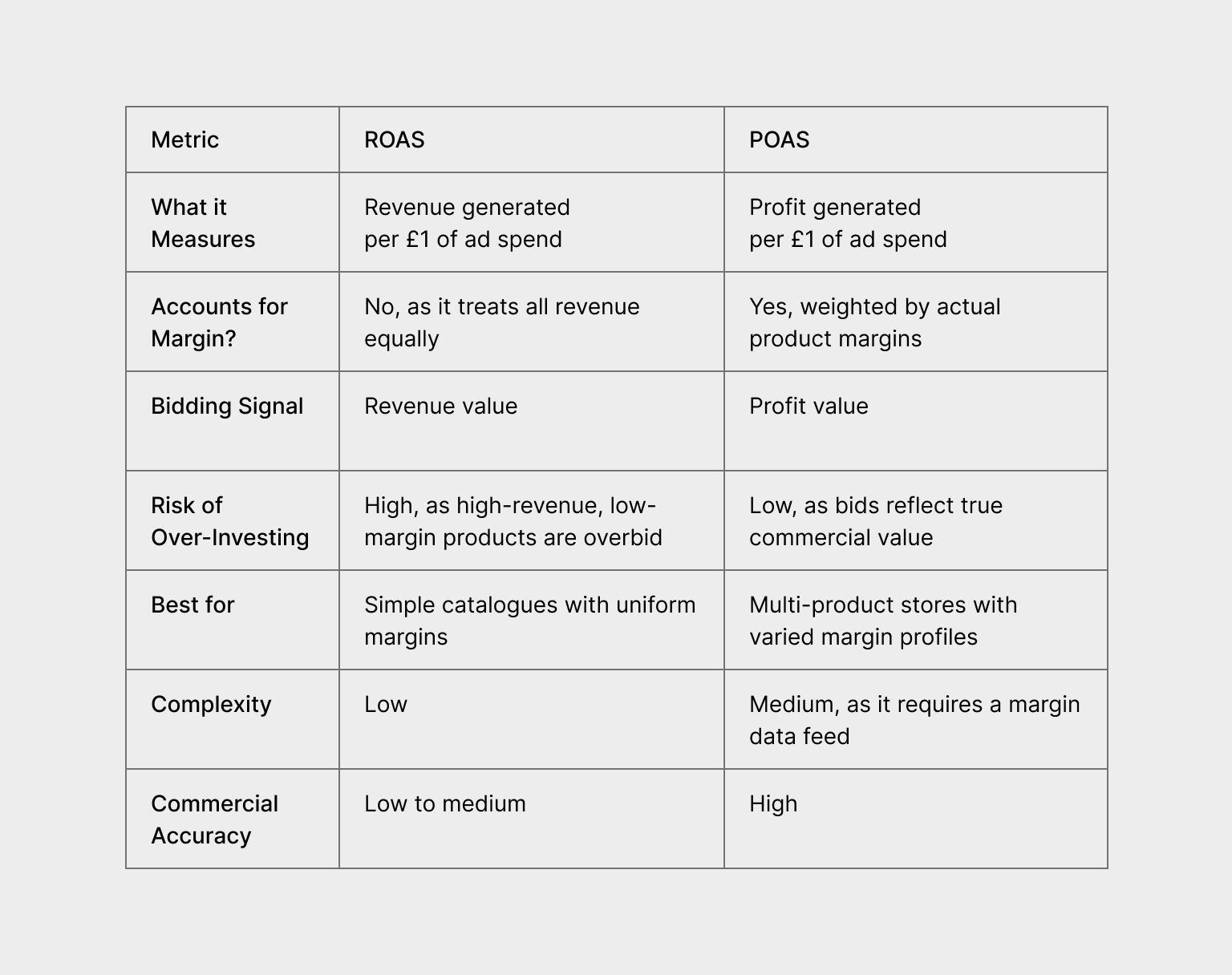
ROAS (Return on Ad Spend) has been the industry-standard bidding metric for years, and in theory it is straightforward. In practice, it has a serious blind spot that catches out a lot of merchants, it treats every pound of revenue as equally valuable, regardless of what it actually costs to deliver.
The Margin Blind Spot
Imagine two products in your catalogue:
- Product A sells for £100 and costs £20 to buy and fulfil. Gross margin: £80 (80%)
- Product B sells for £100 and costs £75 to buy and fulfil. Gross margin: £25 (25%)
Under a standard ROAS strategy, Google treats both products identically. If your target ROAS is 5x, it will bid the same for both, even though Product A generates more than three times the profit per sale. You end up overspending to sell Product B, and potentially under-investing in the products that actually drive your business forward.
This is a pattern we see regularly in stores with broad catalogues, and it is one of the most common reasons why strong ROAS numbers fail to translate into the profitability that owners expect.
ROAS Optimises for the Wrong Goal
The objective of your Google Ads account should be to maximise profitable return, not raw revenue. ROAS can actively work against this by:
- Pushing budget toward high-revenue, low-margin products
- Underinvesting in high-margin products with lower average order values
- Creating a false sense of performance, with strong ROAS numbers that mask weak profitability
- Making scaling decisions based on incomplete financial data
In short, ROAS tells you how much you sold. POAS tells you how much you made.
A Direct Comparison of POAS vs ROAS
Why POAS Makes More Commercial Sense
Switching from ROAS to POAS is not just a technical change, it is a strategic one. For merchants looking to scale with confidence, here is why the commercial case is compelling.
1. You Bid on What Actually Matters
By feeding profit margin data into your bidding signals, Google's Smart Bidding algorithm learns to prioritise conversions that are genuinely worth something. High-margin products get higher bids, low-margin products are bid down automatically. Your ad spend starts working in line with your P&L, not against it.
2. You Scale Confidently
One of the biggest blockers to scaling ad spend is uncertainty. With ROAS, you never fully know whether pushing more budget will generate profitable growth or simply inflate revenue figures with poor-margin sales. POAS removes that uncertainty. When your POAS target is met, you know every pound of incremental spend is generating profitable return, and that is the foundation you need to scale.
3. You Stop Subsidising Unprofitable Sales
Most stores carry a tail of products that technically convert well but generate minimal profit. Under ROAS, these products attract ad spend based on their revenue value. Under POAS, they are naturally deprioritised because their profit signal is weak. This shift alone can significantly improve the overall profitability of your account without reducing overall conversion volume.
4. Your Bidding Reflects Real Business Costs
POAS can incorporate not just product cost of goods but also fulfilment costs, return rates, and other margin-impacting variables. For stores managing complex logistics or high-return categories, this makes your bidding model a genuine reflection of your business economics, which is something a revenue-only metric like ROAS can never achieve.
5. You Get a True Picture of Ad Performance
Reporting on POAS gives founders and finance teams a metric they can directly relate to business outcomes. Instead of explaining why a 6x ROAS might still mean unprofitable advertising, you can demonstrate a clear, auditable link between ad investment and profit generation. It is the kind of clarity that makes scaling decisions straightforward.
How POAS Bidding Works in Practice
Implementing POAS requires passing profit margin data to Google Ads as a custom conversion value, rather than the standard revenue value. This can be approached in a few ways:
- Dynamic Margin Feeds: Product-level cost of goods (COGS) data is used to calculate the profit value of each conversion at the point of sale
- Static Margin Tiers: Products are grouped into margin bands (e.g. low / medium / high) and assigned a representative profit multiplier, which is a practical starting point for stores without granular COGS data
- Server-Side Tagging: For more advanced setups, conversion values are calculated server-side using live margin and cost data before being sent to Google
Once in place, Google's Smart Bidding (Target ROAS or Maximise Conversion Value) operates on profit values rather than revenue values. The target you set is now effectively a POAS target, and Google optimises accordingly.
The key technical components typically include:
- A product-level margin data feed or integration with your pricing or ERP system
- Custom conversion value rules or server-side conversion logic
- Updated Google Ads bidding targets calibrated to profit, not revenue
- A reporting layer that separates revenue and profit metrics for ongoing analysis
Who Benefits Most from POAS Bidding?
POAS delivers the greatest impact for stores where:
- Margin varies significantly across the product catalogue
- High-revenue products are not necessarily the most profitable
- The business is scaling ad spend and needs reliable financial controls
- Current ROAS targets are not translating into expected profit levels
- Founders or marketing teams want advertising KPIs that connect directly to P&L performance
It is particularly well-suited to merchants in competitive categories, where aggressive bidding on high-ticket items can quietly erode margin, and to businesses managing large, varied catalogues where manually adjusting bids at product level simply is not viable.
Common Questions About POAS
Does POAS require a lot of data to work?
You need product-level margin data and a reasonable conversion volume for Smart Bidding to learn effectively. Typically 30 to 50 conversions per month at campaign level is a good baseline. The infrastructure required is far more accessible than it was even two or three years ago, particularly for stores already maintaining a clean product feed.
Can I run POAS alongside ROAS tracking?
Yes, and in fact we recommend it. Running both in parallel during a transition period is best practice. It lets you benchmark POAS performance against your existing ROAS strategy and build confidence in the new approach before fully committing.
Will my revenue drop?
Possibly in the short term, particularly if you have been over-investing in low-margin, high-revenue products. The objective of POAS is to generate more profit, not more revenue, and most accounts see overall profitability improve even if top-line revenue figures adjust. This is the intended outcome, better quality growth, not just bigger numbers.
Is POAS difficult to implement?
For stores with a well-maintained product feed and reliable margin data, implementation is straightforward. For businesses without easy access to COGS data, there may be some groundwork required first, but this is work worth doing regardless of your ad strategy as it makes the entire business more data-driven in the process.
Ready to Make Your Google Ads Work Harder?
If your Google Ads account is generating revenue but not the profit margins you expect, POAS bidding is worth a serious look. It aligns your advertising investment with the metrics that actually matter to your business, and it gives you the framework to scale with confidence rather than hope.
We implement POAS strategies for e-commerce clients across a wide range of sectors, from multi-product retailers to seasonal brands with complex margin profiles. If you would like to explore whether POAS is the right next step for your account, we would be happy to have that conversation.
Get in touch to arrange a free POAS readiness review.