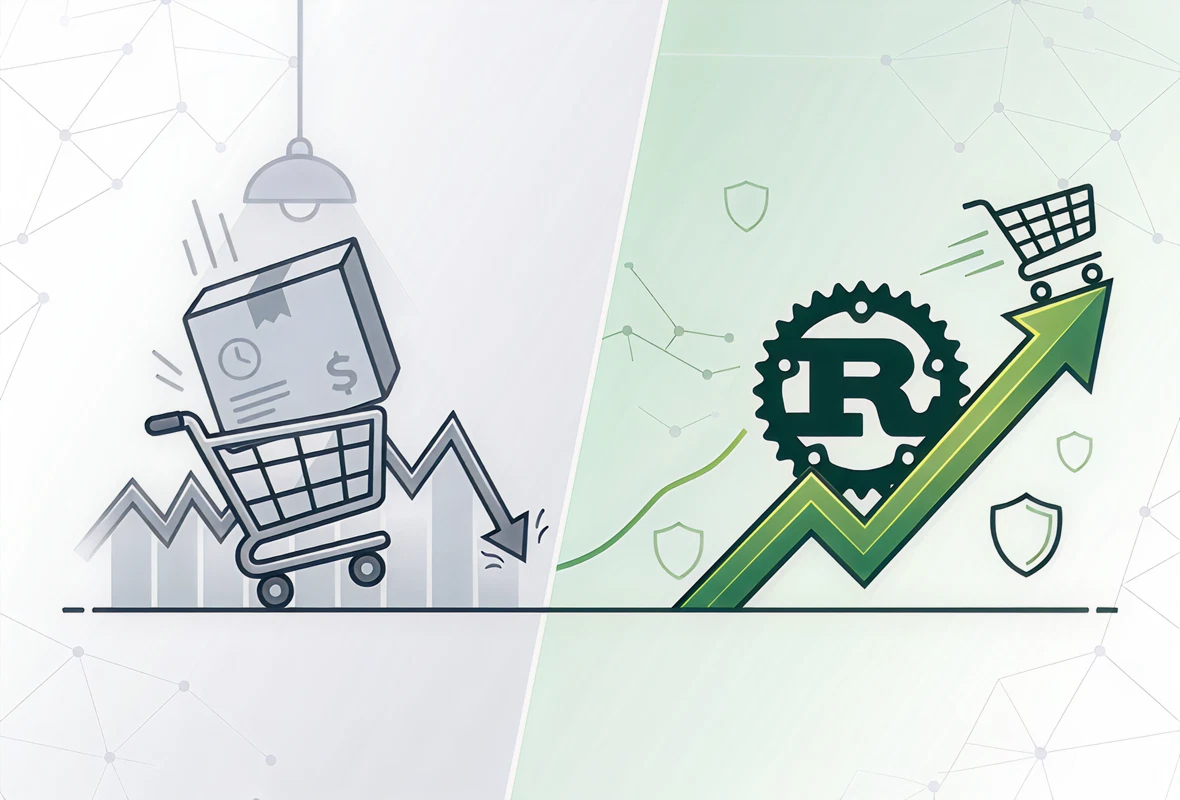


A week ago I built an agentic workflow with one job: take a real customer profile along with a set of real data points based on behavioural analysis, then try to buy a product on a site, flagging every point of friction along the way.
Not because we're building an autonomous shopping assistant. The goal was simpler. I wanted to know whether the technology we now have access to can complete the same journey a customer would:
- Find the right product.
- Understand the differences between options.
- Build enough confidence to commit.
- Buy.

The agent didn't break. No technical error, no broken function, no dead end. It struggled through the journey and would have abandoned it for exactly the same reason customers quietly leave every day.
It got uncertain. Then it gave up.
The filters were fiddly. Touch targets were too small. Telling two products apart took too much interpretation. The information needed to make a decision was scattered across multiple pages, and the one thing the customer actually wanted to know wasn't available until the final step of checkout.
Nothing was fundamentally broken. But at nearly every stage, the experience demanded more effort than today's customer is willing to give.
The agent wasn't surfacing a new problem. It was surfacing problems that had been there all along.
For years, usability testing has run in rounds. We recruit participants, run the sessions, watch where people hesitate, and turn what we learn into a list of things to fix. It's a proven discipline that has generated enormous value for the experiences we build.
You test, you learn, you ship and then the experience moves on without you. New pages go live. Journeys get reworked. Customer expectations shift. The flow you validated six months ago isn't the flow people are walking today.
Between rounds, you're effectively blind. Friction creeps back in, and nobody knows until the next study, if it's caught at all.
Agentic usability testing closes that gap. Instead of waiting for the next round to expose the weak points in a journey, you deploy an agent to go looking for them, continuously. That might sound like a small distinction. It isn't. It turns testing from a snapshot you take a few times a year into a loop that runs all the time.
It doesn't replace human research. People are still, by far, the richest source of insight we have access to. The why behind a behaviour, the hesitation, the thing a customer can't quite put into words. No agent matches that, and I'm not pretending one does.
That's exactly why the two belong together. An agent is only as good as the profile it runs on, and that profile comes from real human insight and real data. You feed what you already know about your customers into a structured workflow, and the agent pressure-tests the experience against it. Continuously, at frequency and speed.
That changes the economics of finding friction. When time and budget are tight, you can get sharp, directional insight fast: where the friction sits, which problems are worth solving, what belongs on the CRO roadmap next. It's not a substitute for deep research. It's how you keep discovery running between rounds of it.
And customer expectations don't hold still. What felt effortless last year reads as friction now. A continuous agentic loop: set up by human insight, fed by data. Keeping the experience moving with those expectations instead of forever catching up to them.
Human insight sets the direction. Data sharpens the profile. The agent tests continuously. The findings feed the next round of human research.
Each pass gets you closer to the optimal experience.
The businesses that win the next few years won't be the ones that react to friction fastest or the ones that bet everything on humans or AI alone. They'll be the ones that combine both, refining the journey continuously and removing friction before it costs them the conversion.
Most Conversion Problems Are Invisible Until They're Expensive
By the time a friction point shows up in your numbers, you've already lost the revenue. Talk to us today and we'll take a proper look at your user journey, identify where traffic is dropping off, pinpoint where conversions are slipping, and put a clear plan in place to fix it.