


Guides
Rust for Shopify Functions is a Commercial Edge, If Only You Could Find Someone to Write It

Bruce Mead
CTO & Founder
12/6/2026
When standard JavaScript hits Shopify’s strict multi-tenant execution limits during peak traffic, it can trigger dropped discounts and conversion-killing latency spikes. While adopting the Rust programming language requires top-tier engineering discipline, it offers high-volume brands a hyper-efficient, bulletproof solution to bypass these bottlenecks natively. Discover the three operational red flags that prove you have outgrown standard code and learn why systems-level architecture is essential insurance for your next major flash sale.

If you have the distinct misfortune of spending your lunch breaks near software engineers, you have likely heard them evangelise about Rust. For years running, it has been voted the tech industry's "most loved" programming language.
But if you are managing a high-volume Shopify Plus store, you do not have the luxury of adopting technology simply because it makes developers feel warm and fuzzy. You care about conversion rates, operational risk, and ensuring your checkout does not implode at 2 AM during a Black Friday flash sale.
With legacy Shopify Scripts officially facing deprecation in favour of the new Shopify Functions infrastructure, standard e-commerce agencies are hitting a wall. When their poorly optimised JavaScript extensions begin to fail under pressure, their default response is usually, "It is a Shopify platform limitation; it cannot be done."
That is rubbish.
Choosing how to build your Shopify Functions is not a technical debate, it is an operational risk assessment. Here is how to look under the bonnet of your e-commerce ecosystem, identify the exact operational red flags that prove you have outgrown standard code, and determine when you must pay the premium for Rust.

The Operational Red Flags & How to Diagnose the Need for Rust
You do not need to be a systems engineer to spot when your architecture is buckling. If your store is humming along nicely, your checkout is fast, and your promotions behave themselves, close this tab. You do not need Rust.
However, if you are pushing Shopify Plus to its absolute limits, Shopify protects its multi-tenant platform with an absolute iron fist. According to their official documentation, any custom checkout logic you inject is strictly capped at an execution limit of 11 million instructions, a compiled binary size of 256 kB, and a mere 10 MB of linear memory.
If your brand matches any of the three operational scenarios below, your standard JavaScript setup is a ticking time bomb.
1. The "Ghost in the Machine" Flash Sale Failure
The Symptom: Your custom discounts, complex bundles, or checkout validations work flawlessly during a quiet Tuesday afternoon audit, but mysteriously stop working during a high-profile product drop or peak trading event.
The Secondary Tech Reality: Traditional JavaScript cannot run natively inside Shopify Functions; it requires bundling a miniature interpreter engine (like QuickJS) inside the file just to read the code at runtime. Under heavy concurrent traffic, this bloated runtime burns through its 11-million instruction allowance just booting up. When it breaches that ceiling, Shopify does not queue the user; it silently drops your custom logic to save its own skin.
The "So What?" Rule: Your bespoke wholesale pricing or flash-sale promotions vanish precisely when traffic peaks. Customers see full retail prices at checkout, abandon their carts, and overwhelm your customer support queue. Rust features zero runtime bloat and compiles directly into pure WebAssembly, executing on a fraction of those instructions so your promotions actually work when you are busiest.
2. The High-Value Checkout "Micro-Stutter"
The Symptom: Your analytics show erratic, unpredictable latency spikes on your checkout page-load speeds, particularly for complex B2B corporate accounts, multi-currency international buyers, or customers with massive cart sizes.
The Secondary Tech Reality: Loosely typed languages like JavaScript rely on a background "garbage collector" process to periodically pause everything and clean up memory. When your checkout is forced to parse complex logic, such as evaluating hundreds of nested customer tags, company hierarchies, and volume discount matrices in real-time, these memory management pauses compound.
The "So What?" Rule: In enterprise e-commerce, a 200-millisecond delay is a direct tax on your conversion rate. Sluggish checkouts breed friction, and friction breeds cart abandonment. Rust runs at a flat line of peak efficiency with near-zero latency, removing the micro-stutters and preserving your hard-earned conversion funnel.
3. The 10 MB Memory Wall
The Symptom: Your checkout completely crashes or refuses to process orders when attempting to calculate complex multi-warehouse shipping routes, regional duty configurations, or product restrictions.
The Secondary Tech Reality: To perform these calculations, your function must ingest and parse data structures exported from an external ERP, WMS, or PIM. Standard JavaScript arrays and JSON parsing are notoriously greedy with RAM, rapidly breaching Shopify's strict 10 MB linear memory limit.
The "So What?" Rule: When an app hits the memory wall and crashes, customers are either blocked from completing their purchase entirely or hit with unoptimised, generic shipping rates that erode your margins. Rust allows for low-level, hyper-efficient control over memory allocation, safely squeezing massive data pipelines into tiny architectural footprints.
The Management Headache of the Rust Talent Deficit
Let us be entirely transparent: if Rust is the definitive answer to platform limitations, why isn't every Shopify extension built with it? Because from a management perspective, resourcing Rust development is an absolute nightmare.
Technical debt is a reality of the trade, but Rust forces you to pay that debt upfront in engineering discipline. It features a brutal learning curve and an unforgiving compiler. Your average frontend team, the brilliant people who maintain your beautiful storefront or adjust your Liquid templates, cannot simply switch to writing systems-level engineering tomorrow morning.
Before authorising a Rust project, you must weigh two non-technical risks:
An Elite Engineering Standard
Rust is simply not a language for standard web generalists. It demands genuine systems engineering discipline, a rare calibre of talent found exclusively within top-tier technical agencies. By partnering with a team capable of architecting in Rust, you are elevating your store’s infrastructure far above the high-street competition. You aren't merely buying a standard Shopify extension; you are establishing a premium, institutional asset that is built to withstand extreme operational stress.
Precision Engineering Over Endless Hotfixes
Because Rust enforces uncompromising mathematical rigour at the compiler level, it fundamentally changes your development dynamic. It trades hasty, reactive coding for bulletproof, deliberate architecture. While top-tier developers will spend more time precisely planning and testing the code upfront, the long-term commercial payoff is immense. You entirely bypass the fragile cycle of emergency midnight patches and compounding technical debt. When a custom feature goes live in Rust, it is built to last, allowing your promotional roadmap to execute with total predictability.
Strategic Comparison at a Glance
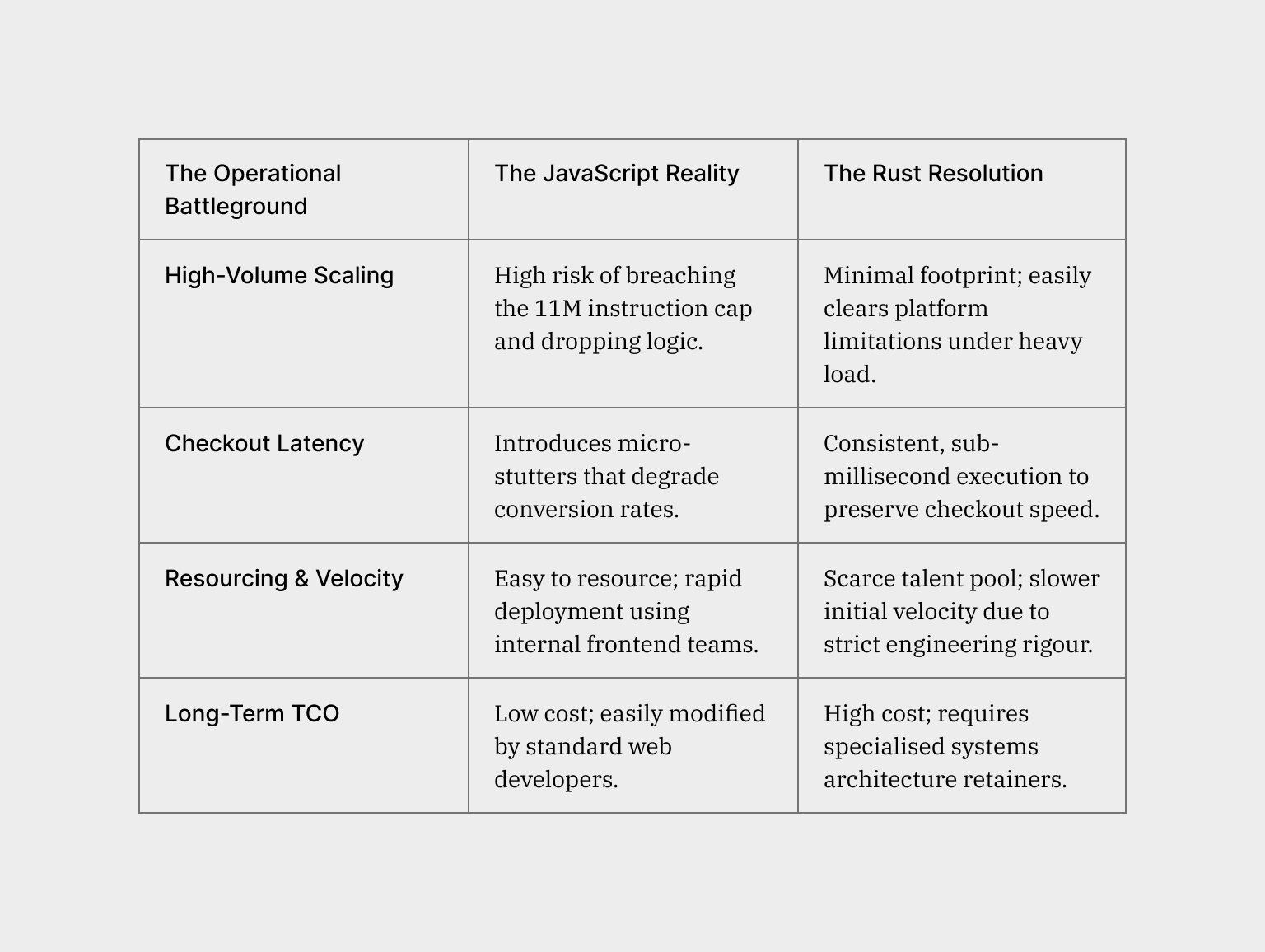
Rust Is Architectural Insurance
Rust is not a marketing buzzword; it is architectural insurance for high-volume digital commerce. If you are running a standard boutique store with predictable traffic, avoid it, the operational overhead and talent scarcity are commercially unjustifiable. Keep your setup simple and your development bills reasonable.
But if you are scaling an enterprise operation where a dropped discount code or a latency spike during a high-profile flash sale directly penalises your revenue, Rust is the only choice. It is an investment in stability that pays dividends exactly when your traffic peaks, ensuring your ecosystem is significantly less likely to crash at 2 AM while your competitors are left holding the bag.
Let’s Talk Architecture, Not Marketing Fluff
If you suspect your current Shopify setup is flirting dangerously with the platform's 11-million instruction ceiling, or if your existing agency has already given you the predictable line that your custom B2B logic "isn't possible" within Shopify Functions, we should talk.
We don't do generic templates, and we won't send you a glossy brochure. We are the team enterprise brands call when they need systems-level engineering to survive peak trading. We have spent years writing production-grade Rust code that runs safely in ultra-isolated edge environments, ensuring complex commercial logic executes in a fraction of a millisecond.
When to Get in Touch
Your checkout is dropping logic.
You are experiencing unexplained promotion failures or vanishing cart customisations during high-traffic drops.
You are hitting platform limitations.
Your internal team has run into Shopify's 256 kB binary size or 10 MB memory wall trying to parse complex ERP or PIM data arrays.
You want architectural insurance.
You are planning a high-volume migration away from legacy Shopify Scripts before Black Friday and cannot afford a 2 AM checkout implosion.
You don't need an internal team of scarce, hyper-expensive systems engineers to exploit the benefits of Rust. You just need access to one that actually knows what they are doing. Get it touch with our team to discuss booking a technical briefing.